


How Digital Processing Opens Up New Possibilities From Mic To Monitor
The history of recording is one of ever-increasing flexibility. Early disc and cylinder systems simply captured whatever was put in front of them. Then, after World War 2, the widespread introduction of magnetic tape made possible editing, overdubbing and multitracking. By the late 1960s it was no longer necessary for the entire performance to be recorded live; instead, each individual element could be recorded separately. MIDI, synths, sampling and digital recording then opened up further possibilities.
Until recently, however, the beginning and the end of the signal chain have been largely the same as they were in the 1950s. All of the main types of microphone we have today were in widespread use 70 years ago. And when it comes to hearing what we’re recording, we still have a choice of loudspeakers or headphones, just as we did back then. The difference is that these are no longer considered a fixed and unchanging element in the signal chain. Today’s engineers have the same level of control over mics and monitoring as we have long had over other elements of the signal path.
Chameleon Microphones
Capacitor or condenser mics have existed in one form or another for a century, and have dominated studio recording for more than half that time. They have long offered the ability to change the polar pattern. This was originally done by replacing the capsule head with a different design, but the invention of the Branmühl-Weber capsule allowed the pattern to be varied simply by changing the polarisation voltages on the front and rear sides of the capsule. We are all very used to the idea that a single microphone can offer cardioid, figure-8 and omni patterns at the click of a switch — but more recent developments have taken this idea and run with it.
Quite a few studio mics now offer the ability to record the signal from the front and rear of the capsule separately, to a stereo channel in your DAW. These two signals can then be recombined after the fact to optimise the polar pattern for the particular context. Austrian Audio even make available a plug-in called Polar Designer which allows the polar pattern to be varied across five frequency bands, so you could for instance, have it be figure-8 in the midrange but cardioid elsewhere.
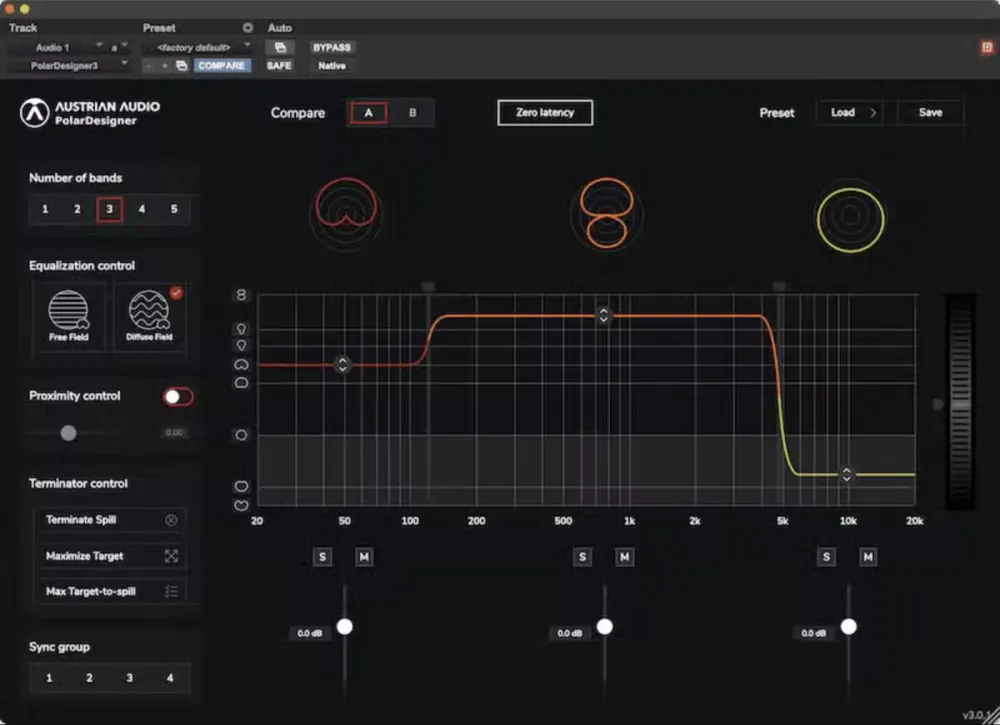
Going even further, Ambisonic microphones are now becoming mainstream. The basic idea is that four capsules are arranged in a tetrahedral array. The outputs from these four capsules are matrixed to a four-channel signal known as the ‘B-format’, which encodes the full three-dimensional sound field arriving at the mic. And from this B-format signal, it’s possible to derive any coincident mono, stereo or surround pickup, pointing in any direction.
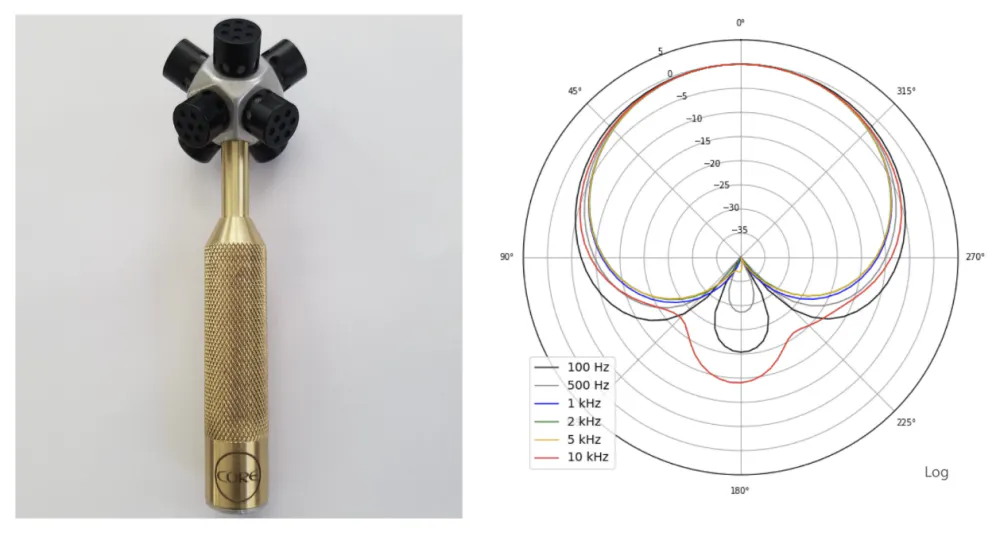
Ambisonic technology was invented in the late 1970s and commercialised by Calrec under the Soundfield name, but for many years it was prohibitively expensive because the matrixing and decoding had to be done using complex analogue hardware. Today, we have plug-in decoders which are cheap to implement and offer perfect accuracy. A good first-order Ambisonic microphone such as the Rode NT-SF1 can be purchased for a similar price to a large-diaphragm studio mic, and offers infinitely greater flexibility. There are also second-order Ambisonic mics such as the Core Sound Octomic and Voyage Audio Spatial Mic, which have eight capsules instead of four and can synthesize polar patterns that are not possible with standard mics.
In recent years, it’s also become possible to radically shape the frequency response of a microphone at source. Again, digital plug-in technology is the key factor here. Manufacturers such as Slate Digital, Townsend Labs / Universal Audio and Antelope Audio have used it to create so-called ‘modelling microphones’, the idea being that you can not only choose the polar pattern after the fact (at least in some cases) but also the tone, from a palette inspired by classic studio designs. So, for example, if you decide at the mix stage that the singer’s voice sounds better on a Telefunken ELA M251 than on a Neumann U47, you don’t need to re-record it, just select a different model within the plug-in.
Open Ended
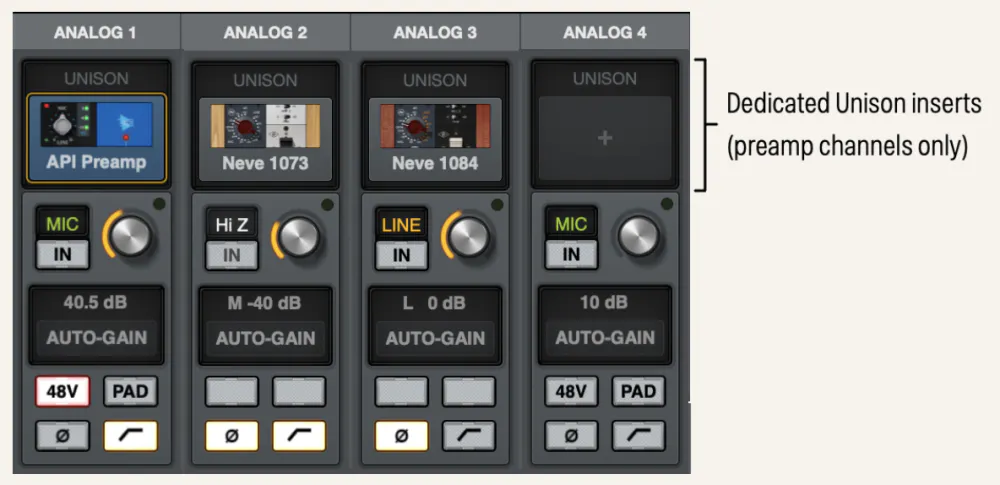
Plug-ins and related technology have introduced similar flexibility elsewhere in the signal chain. For example, Universal Audio’s Unison system extends the same modelling ability to the mic preamp stage, while the options for processing recorded signals in software are now endless. Many widely used plug-ins simply replicate classic compressors or EQs, translating the same processing that has been used for many years into the software realm, but increasingly, modern mixes also depend on modern tools that have no historical equivalent. Obvious examples include real-time pitch correction processing such as Antares’ Auto-Tune. Less obvious examples include multiband compression and dynamic EQ, noise reduction, ‘resonance suppression’ plug-ins such as Oeksound’s Soothe, transient shapers, phase and time-alignment processors and even stem separation tools, which make it possible for example, to remove spill from live recordings.
It’s perhaps easiest to follow the ever-developing possiblities by considering the case of drum recording. Back in the 1930s, the entire group would be recorded on a single microphone or horn, so the only way to change the drum sound was to play differently, move the drums elsewhere in the room, or change the kit. In the 1960s the drums started to get their own track or tracks on tape. Important elements of the kit such as the snare and bass drum would be miked individually, with processing such as EQ and gating applied on the way to tape. The complexity of this approach grew through the 1970s, to the point where it was not uncommon for big-budget productions to spend days working on the drum sound alone. In the 1980s, it became increasingly popular to combine real drums with sequenced or sampled sounds, but it was still necessary to make most of the important decisions at the recording stage.
By contrast, today’s plug-in technology allows us to completely alter the drum sound at the mix stage if we want to. The sound from individual mics can be augmented or replaced by samples. The timing of the performance can be ‘improved’. Gates have become much more sophisticated and able to suppress bleed as well as to accurately isolate individual drums. Virtual and modelling mics as described above allow us to switch from a vintage to a modern sound after the fact. And we can use modern reverb plug-ins to place our recorded kit into any virtual environment.
The Hearing Revolution
As the possibilities for shaping sound at the mix grow ever more extensive, so too does the need for an accurate monitoring system to audition the mix. This has been one of the most rapid areas of development over the last 15 years, and progress is still ongoing. Unlike mix processing tools, playback systems necessarily have an analogue component. Something physical has to convert electrical information into sound waves, and this aspect of speaker and headphone design has enjoyed huge improvements. Active monitors, in which each driver has its own amplifier, are now standard at all price levels. Class-D amplification has hugely improved efficiency. Three-way speaker systems have become affordable. Once-neglected technologies such as coaxial drivers and planar magnetic headphones have been rediscovered, with impressive results. Advanced materials such as rare earth magnets have revolutionised driver performance.
However, perhaps the most significant development in monitoring technology has been the integration of digital signal processing into what was once a purely analogue world. There’s a key difference between monitoring and the other stages of the recording and mixing chain, which is that we have a pretty good idea of what a perfect monitoring system would be like. When we select a microphone or open up a plug-in, we’re making a choice that is both technical and creative. We want it to shape the sound as well as to capture it. By contrast, there’s no creative aspect to monitoring. A studio monitoring system is designed to reproduce sound as faithfully and as accurately as possible.
Although technology has improved hugely over the last two decades, it’s still almost impossible to reach this goal using purely analogue speakers without spending millions. That’s because speakers are always heard within an acoustic environment — and even the best speakers won’t deliver accurate performance in a less-than-perfect room. There is no analogue technology that allows loudspeakers to adapt themselves to the space in order to deliver a more neutral in-room response. The introduction of digital signal processing makes this possible, whether it’s implemented in the speakers themselves, in dedicated hardware, in our audio interface or in software.
Why Calibration Matters
When we listen in a room, we hear a combination of direct sound from the speakers, plus sound that has taken a longer path, reflected by way of walls, ceiling and floor. This combination results in filtering effects at the listening position: for example, reflections from the rear wall, or from a desk or table, typically add a peak in the frequency response at around 150Hz. Importantly, though, these filtering effects are different in every room, so there’s no universal speaker design parameter that can be modified to fix them. They’re also highly complex, and correcting them would require lots of narrow-band EQ curves that would be difficult to implement using analogue technology.
The idea behind digital speaker calibration is simple. A measurement microphone is positioned at or near the listening position, and tones are played back over the speakers. Because the mic and the tones are known quantities, the system can compare what’s actually recorded against the measurements that they should deliver in a theoretical ideal room. An EQ curve that compensates for the difference can then be calculated and applied to everything played back through the speakers.
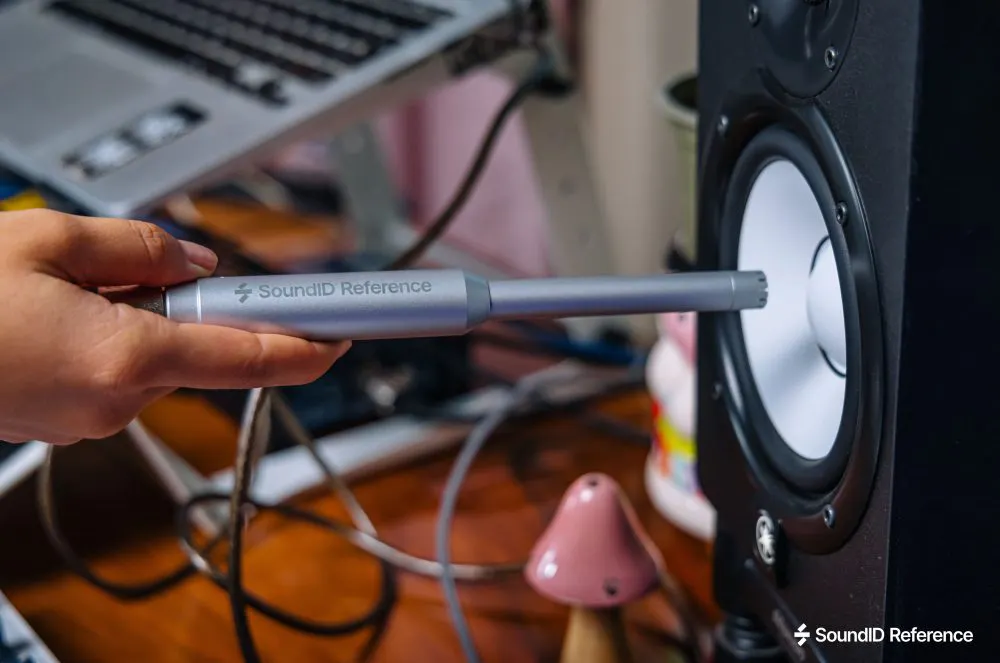
Sonarworks’ SoundID Reference allows this curve to be applied in numerous different ways: as a plug-in on the monitor outputs of your DAW, in a ‘systemwide’ app running in the background on your computer, or on dedicated DSP hardware in compatible speakers and audio interfaces. Hardware implementations are generally cleaner and easier to use, but may run into processing limitations that don’t apply to software.
The power of digital EQ to correct in-room frequency response is remarkable. It can turn a space that is only marginally useful for mixing into a genuinely accurate monitoring environment, as long as two things are borne in mind. First, the improvements typically apply only at the listening position. Digital calibration can’t simultaneously improve the sound at every point within the room, and the EQ curve that makes things sound neutral at the engineer’s seat may have the opposite effect elsewhere. Second, not all frequency-response anomalies are due to reflections. The dimensions of any enclosed space also introduce room modes or resonances, which manifest themselves as big peaks or nulls in the low-end frequency spectrum. These cannot be fully addressed using EQ alone.
The Third Dimension
Speaker calibration is an unambiguously positive addition to almost all stereo monitoring setups. It can add the last 10 percent to a professionally designed and treated control room, or it can make an improvised space into a usable monitoring environment. But as long as we’re still working in stereo, it remains optional. However, calibration becomes absolutely essential in multi-channel monitoring for immersive audio. It’s virtually impossible to design an acoustic space in which 12 or more loudspeakers can operate without coloration being introduced at the listening position. It’s normal for those speakers to be at slightly different distances from the engineer’s seat, meaning that time-alignment as well as EQ is necessary. And the specifications published by companies like Dolby also lay down strict requirements for things like sound levels. It would be very difficult to create a monitoring environment that meets the Dolby Atmos specifications without using digital calibration, and even if it was possible, it would take acousticians and studio technicians weeks to implement. Tools like SoundID Referenceallow anyone to calibrate a monitoring system of almost any size and complexity, without the specialist acoustic knowledge or tools that would otherwise be required.
Calibrating Cans
So what about headphones? Monitoring on headphones takes the room out of the equation, so why would we need calibration in this context?
The first reason is that it’s difficult to design a set of headphones that presents a perfect frequency response. It’s asking a lot of a single driver to amplify all frequencies between 20Hz and 20kHz, and whilst headphones don’t form part of a wider system with the room as loudspeakers do, they do interact in complex ways with the ear and the head. For a set of headphones to sound neutral in use, it actually needs to have a very particular, non-linear response.
Sonarworks pioneered the use of digital EQ to calibrate headphone frequency response. They developed a custom test and measurement setup that can calculate the ways in which any given set of headphones deviates from the ideal, whereupon the SoundID Reference software can apply a suitable corrective curve. Even relatively affordable headphones can be given a remarkably precise frequency response, as long as you own one of the models that has been measured. It’s much more cost-effective to calibrate a cheap pair of headphones than to buy the very best model on the market, and you may find them equally effective as mixing tools.
Virtual Monitoring
The second reason for introducing software into a headphone monitoring chain is that headphones present sound in a very different way from loudspeakers in a room. Not only are there no reflections, but there’s also no crosstalk from left speaker to right ear or vice versa. Nor can headphones directly reproduce multi-channel mixes. Many engineers thus prefer mixing on loudspeakers — but, for practical reasons, that isn’t always possible. And here, once again, software processing can step in to simulate the experience of listening on speakers in a real space.
To recreate how speakers in a room sound to an individual human being, this processing needs to do two things. It must recreate the way in which sound from the speakers travels to the listening position; and it must capture the way in which that human being’s skull, torso and outer ear modify that sound before it reaches the eardrums. In both cases we have the option of simulating how the process works in theory, or measuring its effect in the real world. The simulation approach allows us endless flexibility in terms of recreating virtual spaces, although it can’t exactly replicate a specific real-world studio environment. But the biggest challenge for both simulation and the measurement-based approach is to take account of the full range of variation in human anatomy. The same speakers in the same room will sound different to you and me, because the geometry of our skulls and outer ears is different.
Many room simulation products use a generic set of measurements. If you’re lucky, and the shape of your own ears is reasonably close to the ones that were used to create that set, these products will work pretty well. But they’ll never be as good as products based around exact measurements of your own ears. Sonarworks’ SoundID Virtual Monitoring Pro is currently unique in that it gives anyone the tools to create their own personal virtual monitoring measurements, in as many listening rooms as you like. So if, for example, you’re a mix engineer who needs to work on the move, you can create an accurate facsimile of your own mixing space for headphone listening. Virtual Monitoring Pro closes the gap between speaker calibration and headphone calibration.
The history of music recording is one of ever-increasing flexibility. Innovations such as tape editing, multitrack recording, sampling and digital audio have made recorded sound ever more malleable, at every stage of the process. Speaker and headphone calibration is the latest chapter in this history — but it probably won’t be the last!


