

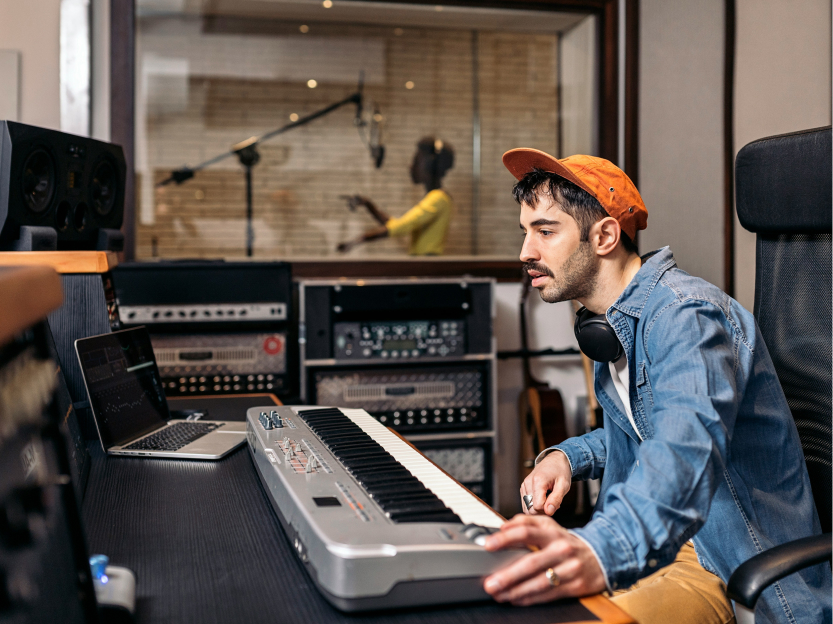
Mixing Headphones Are Now a Main Monitoring Tool
For a long time, headphones were what you checked a mix on after the real work happened on speakers. That has shifted. Plenty of producers now write, edit and mix most of a track on a pair of mixing headphones, and many working engineers use speakers mainly for spot checks. We covered how to make those mixes translate to speakers in a separate article.
This piece looks at the step before that: choosing mixing headphones you can trust. At Sonarworks, we have measured more than 800 headphone models, and our Best Studio Headphones 2026 guide narrows that down to 30 pro models across three price tiers. Below are six lessons from building that guide, the ones we think every creator should know before spending money.
How Headphone Mixing Got Here
Three things moved headphones from the backup position to the desk.
The first is the room. Most music is now made in spaces that were never built for monitoring: bedrooms, flats, shared offices. An untreated room adds peaks and dips in the low end that no pair of speakers can escape. Headphones take the room out of the signal path entirely.
The second is the listener. A large share of your audience hears your work on earbuds and headphones, so getting a mix right in that format is a core skill.
The third is software. Headphone calibration flattens a pair’s frequency response, and speaker simulation such as Virtual Monitoring restores some of the spatial cues headphones lack. A decade ago those tools were niche. In 2026, they come up in almost every forum thread about mixing on headphones.
Why Mixing Headphones Are a Smart Investment for Mobile Creators
A calibrated pair of mixing headphones gives you the same reference at home, in a hotel room, on a train or in someone else’s studio. Speakers can’t do that. Even a great monitor pair sounds different in every room you put it in.
That consistency is the real return on the money. Your ears learn one reference, and every decision you make on it carries over between sessions and locations. Good studio headphones also last: many models in the guide have replaceable ear pads, cables and headbands, so a pair bought today can stay in service for years.
Mobility does add requirements. If you’ll work from a laptop or a small USB interface, check how easy the pair is to drive. If you’ll work in noisy places or record vocals, you’ll want a closed-back model alongside or instead of an open-back. And if the pair goes in a bag every week, build quality and spare parts start to matter as much as sound.
Six Lessons for Choosing Mixing Headphones From 800+ Measurements
1. The spec sheet tells you very little
Every modern studio headphone covers the full range of human hearing, so a frequency range printed on the box won’t separate one model from another. Distortion figures are usually quoted at 1 kHz, where no current pro model has a problem. Impedance alone doesn’t tell you if your laptop can drive a pair; you need sensitivity too, and some 250-ohm models run fine from a phone. Price is no guarantee either. Paying more often buys better materials or a different design, and not necessarily a more accurate tool.
2. Sub-bass distortion is the one thing calibration can’t fix
Calibration corrects frequency response. It can’t remove harmonic distortion, and in headphones that shows up mostly in the sub-bass. Several legendary open-backs, including the Sennheiser HD 600, HD 650, Drop HD6XX and Drop HD58X, don’t deliver the cleanest sub-bass for this reason. The Philips SHP9500S and Sennheiser HD800S also measure relatively high THD down there, and the Shure SRH1540 has distortion you can hear on sub-heavy material.
If you make bass-driven music, look for mixing headphones at the low-THD end of the guide: the Audio-Technica ATH-M50x and ATH-R70x, the Audeze LCD 2C, the Fostex TH610 and TH900mk2, and the Audeze MM-500 and LCD-5, which we rate for exceptionally neutral sub-bass. Even at entry level it varies; the Samson SR850 measures less THD than the Superlux HD 681.
3. Calibration changes which headphones make sense
Some models sound close to neutral straight out of the box. The Sennheiser HD 600, HD 650, Drop HD6XX and Audio-Technica ATH-R70x have exceptionally flat frequency response, and the AKG K612 Pro, Neumann NDH 30 and even the budget ATH-M20x are close behind.
Others are heavily coloured on their own and become excellent once calibrated. The Focal Listen Pro, Sony MDR-MV1 and Austrian Audio Hi-X65 fall into this group, and the Austrian Audio Hi-X50 has its own mid-frequency character. With SoundID Reference active, the Sennheiser HD 490 Pro beats the HD 650 for accuracy, which is why it is the guide’s top recommendation. If you plan to calibrate, frequency response drops down your list of priorities and the next three lessons move up.
4. Open-back for accuracy, closed-back for context
Open and semi-open designs tend toward flatter response and a more natural sound, and most of the guide’s picks use one. The trade-off is leakage both ways: everyone near you hears your mix, and you hear the room.
Closed-backs earn their place for tracking vocals, working on the move and sharing a space. The guide’s closed options include the Beyerdynamic DT 270 Pro, Audio-Technica ATH-M50x, Austrian Audio Hi-X50, Focal Listen Pro and Shure SRH1540. Closed doesn’t always mean isolated, though. The Fostex TH610 and TH900mk2 are closed-back yet isolate weakly, which suits a quiet room better than a train.
5. Comfort decides whether you finish the session
Mixing headphones you can’t wear for four hours are no use to you, however well they measure. Weight matters: the Audio-Technica ATH-R70x (210 g) and Sony MDR-MV1 (223 g) sit at the light end, and the HD 490 Pro is the most comfortable model in its class in our testing. The Beyerdynamic DT 880 Pro and HEDDphone D1 also score well. At the other end, the Audeze LCD 2C (544 g) and HEDDphone One (730 g) are heavy enough to make long sessions hard work. Entry-level models such as the Superlux HD 681 and ATH-M20x are where comfort usually gets cut first.

6. Check serviceability and availability before you pay
A detachable cable is a small detail until yours fails. The Superlux HD 681, Samson SR850, ATH-M20x, Audio-Technica ATH-R30x, AKG K612 Pro and DT 880 Pro all have fixed cables. Models with easy spare parts, such as the Beyerdynamic DT 900 Pro X, DT 880 Pro and DT 270 Pro, are easier to keep in service for years.
Availability can change faster than a guide can be updated. Drop stopped operating as a standalone store in March 2026; the HD58X sold out, and the HD6XX was still sold by Sennheiser in the US only at that point (SoundGuys). Check stock in your region before you build a plan around a specific model.
Where to Start: Mixing Headphones by Workflow
The guide sorts all 30 models into entry-level, mid-range, mid range and high-end, from around €25 to €5,500, with weight, cable, pros and cons for each. Use your workflow to decide which pages to read first.
| If you mostly… | Start with |
|---|---|
| Mix and master long sessions at home | Sennheiser HD 490 Pro, HD 650, HD 600, Audio-Technica ATH-R70x |
| Make sub-heavy electronic or hip-hop music | Audeze MM-500, Audeze LCD-5, Fostex TH900mk2 |
| Track vocals and work on the move | Beyerdynamic DT 270 Pro, Audio-Technica ATH-M50x, Austrian Audio Hi-X50 |
| Want the lightest possible pair | Sony MDR-MV1, Audio-Technica ATH-R70x |
| Need something under €100 to start with | Superlux HD 681, Samson SR850, Audio-Technica ATH-M20x |
Download the free Best Studio Headphones 2026 guide for the full breakdown of every model, including our Great Value and Hall of Fame picks.
Mixing Headphones Checklist Before You Buy
Most mistakes people make when buying mixing headphones come from choosing on reputation or price alone. Run through these before you order:
- Will you calibrate? If yes, weigh comfort, THD and build above out-of-the-box sound.
- What genre do you mix? Bass-heavy work needs a pair with low sub-bass distortion.
- Where will you work? Quiet room suits open-back; shared or noisy spaces need closed-back.
- What will drive it? Check sensitivity and impedance against your interface or laptop output.
- How long are your sessions? Check the weight and try the clamp force if you can.
- Can you service it? Look for a detachable cable and replaceable pads.
- Can you buy it locally? Confirm stock and warranty in your region before deciding.
FAQ
Can you mix professionally on headphones? Yes. Many engineers now do most of their mixing on headphones and use speakers for final checks. Calibration and a consistent reference matter more than the format.
Are open-back mixing headphones better than closed-back? They tend to have flatter response and a more natural presentation, so they suit mixing in a quiet room. Closed-backs are the better choice for recording and noisy spaces.
Do expensive mixing headphones sound more accurate? Not reliably. Paying more doesn’t necessarily get you a more accurate tool. Comfort, distortion and build often matter more once you calibrate.
What does calibration fix, and what doesn’t it fix? Calibration corrects a headphone’s frequency response toward a neutral target. It can’t fix harmonic distortion, poor comfort or a broken cable, which is why those factors drive our picks.
Do I need a headphone amp? All 30 models in our guide play at ample volume from virtually any modern audio interface. The DT 880 Pro is harder to drive than its rivals, so check your output level if you plan to work from a laptop.
Get the Full Picture
Headphones are now a primary tool for a lot of creators, and the right pair can serve you for years in any room you work in. Choosing mixing headphones is easier once you know what to ignore on the spec sheet and what to check instead.

Our Best Studio Headphones 2026 guide covers all 30 models in detail, from the Superlux HD 681 to the Audeze LCD-5. It’s free to download. Already have your pair? Try SoundID Reference free for 21 days and hear what it sounds like flat.


