


Yes, within limits. AI can change how your voice sounds, and it can make a good take sound more polished and professional. What it will not do is turn a flat note into a good one. Those are two separate jobs, and understanding the difference is the whole answer to this question.
The short version
People asking this usually mean one of two things. The first is tuning and timing: getting your notes on pitch and your phrases on the beat. The second is tone and character: the colour and identity of the voice itself. AI handles both, through different kinds of tools. SoundID VoiceAI works on the second. It transforms the tone of your voice while keeping your performance, your pitch and your phrasing exactly as you sang them.
The two things “better” can mean
Tuning and timing. This is the job of pitch correction. Tools such as Auto-Tune and Melodyne detect notes that are flat or sharp and move them to the intended pitch, and they can nudge phrases that rush or drag back onto the grid. This is about accuracy.
Tone and character. This is voice transformation, sometimes called timbre transfer. Instead of correcting your accuracy, it reshapes the acoustic fingerprint of your voice toward a different target, while your pitch, vibrato, dynamics and phrasing carry through untouched. This is about identity and colour.
Here is the distinction at a glance:
| Pitch correction | Voice transformation | |
|---|---|---|
| What it changes | Whether notes are on pitch and on time | The tone and character of the voice |
| What it keeps | The voice’s own tone | Your pitch, timing, phrasing and expression |
| Typical tools | Auto-Tune, Melodyne | SoundID VoiceAI |
| Best for | Cleaning up an accurate take | Changing how a take sounds, or who it sounds like |
If you only take one thing from this article: pitch correction fixes your accuracy, voice transformation changes your sound. They solve different problems, and you can use them together.
What SoundID VoiceAI actually does
SoundID VoiceAI is a voice changer that runs as a plugin inside your DAW. You sing or hum a line, then apply a preset, and the AI supplies a different voice or instrument on top of your performance. Your take drives everything. The slides, the vibrato and the emotion you recorded all carry into the output, which is why transformed vocals feel human rather than synthetic.
That covers voice-to-voice, where you move your take toward the timbre of another singer, and voice-to-instrument, where a hummed melody becomes a brass line or a string part. For a fuller map of how cloning, conversion and synthesis fit together, read Voice AI 101: Cloning, Conversion, and Vocal Synthesis Explained.
The library now runs past 100 presets, and every voice pack is trained on licensed material with the performers’ consent. In a year when AI voice tools draw real scrutiny over consent and likeness, how a voice model was trained matters as much as how it sounds.
What AI can and cannot fix
AI voice transformation can move your tone toward a target voice, thicken a single take into a wide stack of doubles, and salvage a source recording that has some background noise. It reconstructs the vocal rather than filtering it, so the result tends to sit in a mix with less corrective work afterward.
What it will not do is tune you. VoiceAI preserves your pitch, so if you sing sharp, the transformed voice comes out sharp too. The same goes for timing. If the accuracy of a take is the problem, fix that first with pitch correction, then transform. There is a right order to this, and getting it wrong introduces artefacts.
The rule holds across both tools: start with a solid take. AI is for refinement. It is not a rescue for a performance that has not been learned yet.
How to get natural results
Capture a clean take with proper mic technique and minimal room noise. If your source is a little noisy, run Captured Voice Cleanup, added in the June 2026 update, to reduce noise before processing and improve the output.
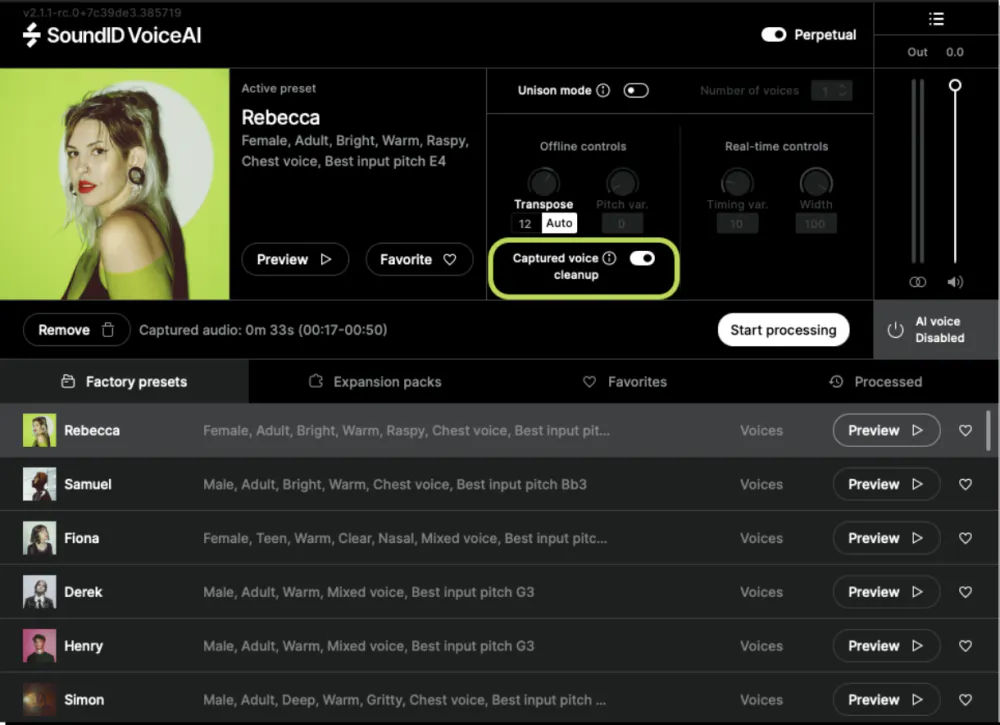
Pick a preset that sits close to your own range. Each preset lists the input pitch that gives the best result, and if the range gap is wide you can use Transpose to shift the output by semitones before reprocessing. Then monitor the transformed vocal inside the full mix rather than in isolation, since a setting that sounds perfect solo can feel exaggerated once the track is around it. Keep the processing light unless you are deliberately going for an effect.
What is new in SoundID VoiceAI for 2026
A few releases change how you would use it since this question was first worth asking.
Unison double-tracking. Unison mode generates up to eight natural double tracks from one vocal, with pitch and timing variance, so you get a wide, full vocal without recording multiple manual takes.
Captured Voice Cleanup. The June 2026 SoundID VoiceAI update reduces noise in the source recording so the model has cleaner material to work from.
Pricing options. Perpetual mode unlocks unlimited local processing for a one-time payment, and Pay-as-you-go token packs cover cloud processing when you want it. Check the live product page for current pricing before you commit.
The plugin is also frequently being updated with new voice packs.
Frequently asked questions
Does AI actually make you a better singer? It makes you sound more polished and lets you change the character of your voice, so a good take can sound professional from a home setup. It does not build technique such as pitch accuracy, breath control or range. Those still come from practice.
Does SoundID VoiceAI correct pitch? No. VoiceAI transforms the tone of your voice and keeps your pitch and phrasing intact. If you need to fix off notes, use a pitch correction tool first, then transform.
Is AI voice transformation the same as Auto-Tune? No. Auto-Tune is pitch correction, which changes whether your notes are on pitch. Voice transformation changes the tone and identity of the voice while leaving your pitch as you sang it.
Can I use SoundID VoiceAI for free? Yes. The freemium tier gives you 8 presets with unlimited local processing at no cost, and a 7-day trial opens up the full preset library and cloud features.
Try it on your own voice
The fastest way to understand what AI can do for your sound is to hear it on a take you already have. Start free with a 7-day trial for the full library. AI will refine your sound while the performance stays yours.


