

Can You Turn Your Voice Into Drum Tracks?
Imagine beatboxing your perfect rhythm and turning it into a full drum track in seconds. With today’s AI-powered tools, you can turn beatboxing into drum tracks that sound as polished and dynamic as professional recordings. Whether you’re a producer, engineer, or beatmaker, your voice can now act as a true rhythm instrument.
This approach removes the barrier between your musical ideas and your DAW. You perform rhythm as you hear it, and the AI translates it into drums that sound ready for release.
Why Beatboxing Creates Better Drum Grooves
When you beatbox, you’re not just imitating a drum kit — you’re expressing rhythm directly through breath, timing, and movement. That physicality embeds groove in a way that quantized programming rarely can. Your voice naturally shapes micro-timing, dynamics, and phrasing that make a rhythm feel human.
Programmed drums tend to be consistent and precise, but often lack those imperceptible deviations that make rhythm alive. A slight delay on a snare, a softer hi-hat before the downbeat, a breath between phrases — these are the cues that define natural groove.
Beatboxing also engages intuition. It’s immediate and improvisational. You can stumble upon rhythmic phrases that would never appear through a grid or step sequencer. In that way, the process mirrors how real musicians interact with timing: fluid, expressive, and full of nuance.
For a deeper dive into why rhythmic imperfection creates emotional connection, you can explore Berklee College of Music’s research on groove and timing.
How SoundID VoiceAI Turns Vocal Beats Into Drum Tracks
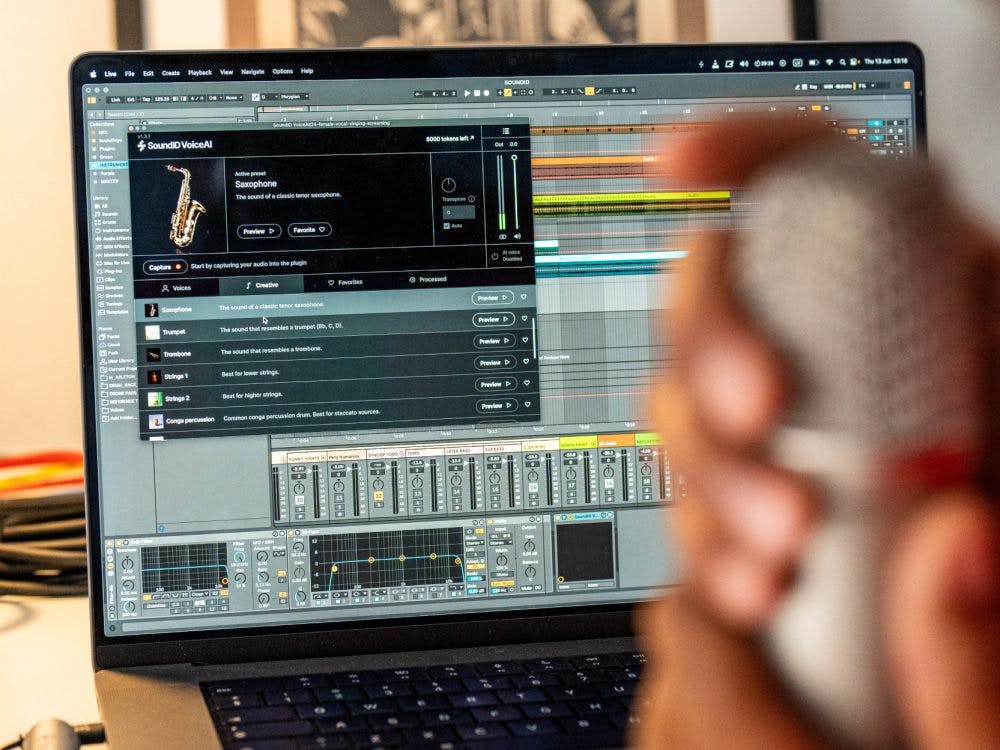
SoundID VoiceAI plugin analyzes your voice and converts it into realistic, mix-ready drum sounds. It listens to the shape, intensity, and timing of each percussive syllable, then maps them to the closest corresponding drum elements.
Here’s how it works in practice:
-
Sound Identification: The AI detects percussive categories such as kicks, snares, hi-hats, and toms.
-
Timing and Dynamics Analysis: It interprets your rhythmic phrasing, swing, and volume variations.
-
Sample Mapping: Each sound is replaced by a high-fidelity drum sample that matches your timing and energy.
-
Groove Preservation: The AI maintains your natural feel instead of quantizing everything to a fixed grid.
The result is a set of drums that sound programmed in precision, yet performed in expression. Your voice drives both the structure and the soul of the rhythm.
How to Record Beatboxing for Best AI Conversion
A strong recording is the foundation for accurate conversion. Even a modest setup can yield excellent results if you record cleanly and clearly.
Tips for optimal performance:
-
Choose a quiet space with minimal reflections or background noise.
-
Use a pop filter to reduce plosives.
-
Keep your mouth at a consistent distance from the microphone.
-
Separate each sound — kicks, snares, and hats — clearly in your performance.
-
Avoid layering multiple percussive sounds at once.
Dynamic microphones handle loud transients well, while condensers capture more nuance. What matters most is clarity. When the AI can distinguish each transient and tone, the results will sound more intentional and expressive.
Five Creative Techniques to Enhance Your Voice-to-Drum Workflow
-
Layer Multiple Takes: Record separate passes for different drum elements, then mix them together for complexity and depth.
-
Use Gentle Compression Before Conversion: This evens out your performance, helping the AI interpret transients accurately.
-
Combine AI-Generated Drums with Programmed Layers: Keep the human groove, but reinforce it with tight, electronic accents.
-
Mix Like Live Drums: Apply subtle EQ, compression, and ambience to shape the converted tracks as you would with recorded percussion.
-
Explore Unusual Sounds: Mouth clicks, pops, or even vocal fry can transform into inventive percussion textures.
This workflow balances spontaneity and polish. You capture rhythm with natural feel, then refine it using the same techniques that make professional drum recordings punch through a mix.
Voice-to-Drum Applications Across Genres
Producers and creators are already using this approach across a wide range of genres.
In electronic music, it adds a subtle swing and human pulse to sequenced beats.
In hip-hop, it creates signature grooves that reflect the performer’s vocal flow.
In indie and experimental music, it introduces an organic percussive layer that sits between acoustic and synthetic textures.
Even sound designers find creative uses — turning vocal gestures into hybrid percussive soundscapes that feel alive.
This process gives you the expressive fingerprint of a live performer, captured and enhanced through modern production tools.
Beyond Drums: The Expanding Role of the Human Voice in Production
AI music systems are increasingly able to interpret pitch, timbre, and rhythm from a single source — the voice. That means the same principles behind converting beatboxing into drums can turn a hum into a bassline, or a sung phrase into a synth melody.
This integration of vocal performance and digital modeling represents a shift in how music is created. The voice becomes not only the emotional center but also the structural core of a composition. You can now sketch full ideas without leaving the microphone.
Final Thoughts: When Human Feel Meets Machine Precision
Turning beatboxing into drum tracks isn’t just a technical shortcut. It’s a creative bridge between instinct and production. You perform rhythm the way it feels right, and the technology translates it faithfully into sound that meets professional standards.
That blend — of human groove and digital precision — defines the next chapter of music production. When you start with your voice, you start with something that already moves listeners. SoundID VoiceAI helps you preserve that movement, translating it into rhythm that’s as expressive as it is exact.
FAQ
Do I need to be an experienced beatboxer?
No. Even simple “kick-snare-hat” patterns will work. The AI enhances timing and articulation automatically.
Can I use any microphone?
Yes. A dynamic mic is perfectly fine, but higher-quality microphones capture more detail for cleaner results. Learn more about choosing your first mic in our blog article.
Does it work in all DAWs?
SoundID VoiceAI integrates seamlessly with all major digital audio workstations.
Can I mix the converted drums like real recordings?
Absolutely. You can apply EQ, compression, and effects just as you would with a recorded drum kit.


