


Chinese-language pop is one of the fastest-moving vocal styles in global production, and it’s also one of the hardest to demo if the right singer isn’t sitting in your session. A Mandopop ballad needs a very different vocal identity from a Cantopop hook or a hard-hitting C-pop dance record, and getting a convincing reference down early is often the difference between a track that lands with an A&R or sync supervisor and one that stalls.
This guide is about the production side: what actually distinguishes these vocal styles, how timbre transfer behaves when you’re working in a tonal language, which voices suit which brief, and the engineering details that separate a throwaway demo from a usable guide vocal. If you just want the launch details and pricing, the C-pop Voices Expansion Pack announcement covers those.
Mandopop, Cantopop, C-pop: what’s actually different
“C-pop” is an umbrella, not a single sound. Producing convincingly means knowing which room you’re writing for.
Mandopop is the largest of the three by audience, Mandarin-language pop with roots across Mainland China, Taiwan and the wider Sinophone market. The signature is melodic, lyric-forward and often ballad-leaning, with a lot of emotional weight carried in sustained notes and controlled vibrato. Even up-tempo Mandopop tends to prioritise a clean, intimate lead over aggressive processing.
Cantopop is Cantonese-language pop, historically centred on Hong Kong. It carries its own melodic phrasing conventions and a distinct pop lineage, and the tonal structure of Cantonese shapes melodies differently from Mandarin (more on that below).
Contemporary C-pop and C-pop dance borrow heavily from K-pop and Western pop production: tighter rhythmic phrasing, brighter top-end, stacked harmonies and hooks built for short-form video. This is where layered, radio-forward vocal treatments earn their keep.
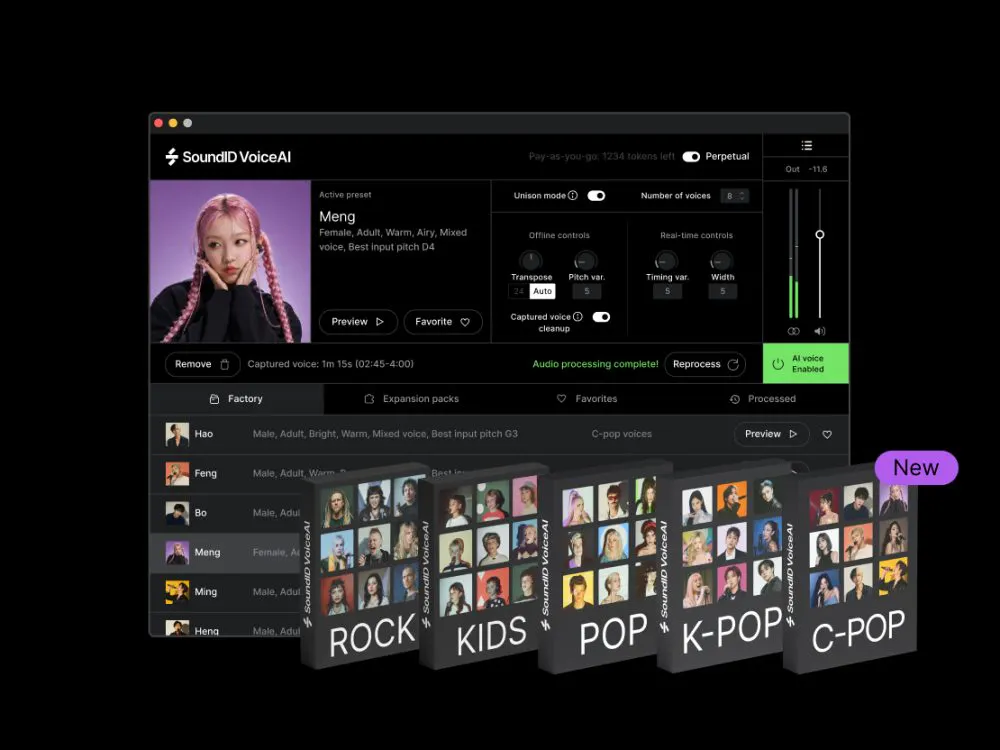
The Chinese Voices pack was built to cover this spread, and one style worth flagging that often gets overlooked is donghua (Chinese animation), where a distinctive vocal character is needed for theme songs, inserts and character vocals. If you score for animation or games, that’s a use case worth testing directly.
The part most tutorials skip: timbre transfer in a tonal language
Here’s the mechanic that matters, and it changes how you should record.
SoundID VoiceAI transforms timbre, not performance. It doesn’t generate a vocal from a text prompt and it doesn’t “sing Chinese for you.” You sing the line yourself: the melody, the phrasing, the pronunciation, the emotion. The model then rebuilds the tone colour of that take in a new voice. Your performance drives everything.
For English-language work that’s straightforward. For tonal languages it’s a critical detail: Mandarin carries four main tones plus a neutral tone, and Cantonese has six. Pitch contour isn’t just melody, it’s part of the meaning of the word. Because VoiceAI preserves your pitch and phrasing, the diction and tonal accuracy of the source take carry straight through to the result. The model supplies an authentic vocal identity. It does not correct mispronounced tones or fix diction.
Practical consequence: if you’re producing Mandopop or Cantopop and you’re not a fluent speaker, get the guide vocal from someone who is, or track against a reference from a native singer. A phonetically shaky source take will produce a phonetically shaky result in a lovely voice, which is worse, because it sounds finished. This is the most common way producers get burned with tonal-language vocal tools, and it’s entirely avoidable.
Because the whole transformation happens inside your DAW, with no browser uploads and no file round-trips, you can iterate on the take fast: re-sing, re-render, compare, without ever leaving the session.
The 10 voices: hear them in context
The pack ships 10 studio-grade voices, five male and five female, trained on licensed, ethically sourced material. Rather than describe them, listen. Each sample below is the same category of source performance transformed through that voice, so you can hear how it sits.
Audio samples
Male voices
Hao
Feng
Bo
Ming
Heng
Female voices
Mei
Lian
Meng
Fei
Ying
A quick engineering note when you audition: each voice model has an optimal input pitch range. Matching your guide vocal to a voice’s best input range, rather than forcing a low male take through a bright female model or the reverse, is the fastest way to get a natural, artefact-free result. If a voice sounds strained, transpose the guide into its range before you reach for anything else.
Who this pack is for, by role
Sync and library composers. This is the clearest fit. Sync briefs frequently call for authentic Chinese-language vocal character on deadlines that don’t allow for casting, booking and tracking a session. A convincing Mandopop or Cantopop lead down in an afternoon, cleared, consistent, and ready to submit, is exactly the gap this fills.
Topliners and songwriters. Write the Mandopop ballad topline, hear it back in a voice that suits the brief, and pitch a demo that communicates intent instead of a scratch vocal that undersells it. Faster to explore multiple melodic directions before you commit to a session singer.
C-pop, Mandopop and Cantopop producers. Build the full arrangement around a placeholder lead that already sounds like the genre, then swap in your final vocalist when they’re available, with a reference that tells them precisely what you’re after.
Donghua, anime and game composers. Character vocals, theme songs and inserts that need a specific Chinese vocal identity, without a casting cycle for every cue.
Content creators and podcasters. Distinctive vocal character for short-form, intros and content where a specific timbre adds identity.
Production and engineering tips
- Track the guide vocal cleanly. Timbre transfer is only as good as the source. Minimal room, controlled sibilance, no heavy processing baked into the take. You want the model reading a clean performance, not fighting your reverb.
- Nail tones and diction at the source (see above). No plugin fixes pronunciation.
- Match input pitch to the voice’s range before transposing anything else.
- Stack with Unison Mode for doubles, harmonies and wall-of-vocal C-pop textures, particularly effective on dance-leaning records where layered stacks are part of the sound.
- Mind Mandarin and Cantonese consonants and sibilance in the mix. Retroflex and affricate consonants sit differently from English, so check your de-essing and high-mid balance on the transformed vocal rather than assuming an English-vocal chain will translate.
- Comp on the source, not the output. Get the performance right first, then transform. Cheaper and cleaner than trying to fix a rendered take.
See how creators are using SoundID VoiceAI
The fastest way to understand what these voices unlock is to watch producers work with them. The playlist below rounds up creators already using SoundID VoiceAI in real projects, from quick demo production to full vocal stacks.
[YOUTUBE PLAYLIST PLACEHOLDER]
Where the Chinese Voices sit in the wider library
SoundID VoiceAI’s expansion library is regional and genre-specific by design, which makes it a toolkit rather than a single sound. If you work across markets:
- Korean Voices and K-pop: K-pop, J-pop-adjacent and anime work, launched alongside the freemium tier.
- Pop Voices: contemporary Western pop and chart-forward leads.
- Rock and Kids Voices: grit and wide dynamics; bright child vocals.
For genre-blending records, a C-pop hook over a Western pop production, say, reaching across two packs in the same session is often where the interesting results come from. You can preview the full catalogue in the preset library.
Responsible AI, specific to voice models
Generic “AI empowers, doesn’t replace” statements are easy. What actually matters with a voice model is narrower and more concrete, so here’s the specific position.
Every voice in the Chinese Voices pack was built from licensed, ethically sourced material, created in collaboration with professional singers who gave explicit consent and were fairly compensated. That’s the line that matters for a tool that reproduces vocal identity: the people whose performances trained these models agreed to it and were paid.
Sonarworks stands for the responsible use of AI in music as part of the Principles for Music Creation with AI, the framework introduced by Roland and Universal Music Group and backed by dozens of music-technology companies. It centres transparency, respect for creators’ rights, and technology that amplifies rather than displaces human artistry.
For producers, the practical implications are worth stating plainly:
- Cultural authenticity over imitation. These voices exist to give creators access to authentic Chinese vocal character built with Chinese vocalists, not to approximate a culture from the outside. Used well, that’s a tool for respectful, informed production. It still rewards knowing the genre you’re writing for.
- A demo and pre-production tool, not a ghost. The strongest workflow uses these voices to communicate intent: guide vocals, temp tracks, references for the human singer who ultimately performs the record.
- Transparency in your own work. How you disclose AI-assisted vocals to collaborators, labels and sync clients is your call, but do it deliberately. Norms are still forming, and clear communication protects the relationship.
FAQ
Can SoundID VoiceAI sing in Chinese for me? No. It transforms the timbre of a vocal you record, it doesn’t generate lyrics or pronounce words for you. You sing the Chinese, the model supplies the voice.
Do I need to speak Mandarin or Cantonese to use it? To get a genuinely usable result, the source performance needs correct pronunciation and tones. If you’re not a fluent speaker, work with one or track against a native reference. The model preserves whatever diction you feed it.
Which voices suit Cantopop vs Mandopop? Both are covered, and the best match depends on the specific brief and register more than the dialect. Audition against your guide vocal’s range and let the samples decide.
What do I need to run the pack? It requires a SoundID VoiceAI perpetual licence, activates on three devices, and runs as a plugin inside your DAW (Windows and macOS). See the product page for current system requirements.
Do the Chinese Voices require tokens? No. With a perpetual licence, local (offline) processing is unlimited and token-free. Tokens only apply to optional cloud processing, at 10 tokens per second with a 7-second minimum per render.
Can I use these vocals in commercial releases? Yes, all presets are ethically sourced, all artists have been fairly paid. Any original output made with SoundID VoiceAI is royalty-free.
Try the Chinese Voices
The pack is available now, and there’s a 7-day free trial with full access to the voice and instrument catalogue if you want to test it against a real brief before committing.


